
Logo Light
Logo Light
Contact Us
hello@growingstar.in
+91-6307034344
Mon - Sat (9AM - 7PM)

Follow Us

πŸ”’ Learning
Ages: 5+ years

Dyscalculia
Treatment in Lucknow

Numbers make sense β€” let us show you how

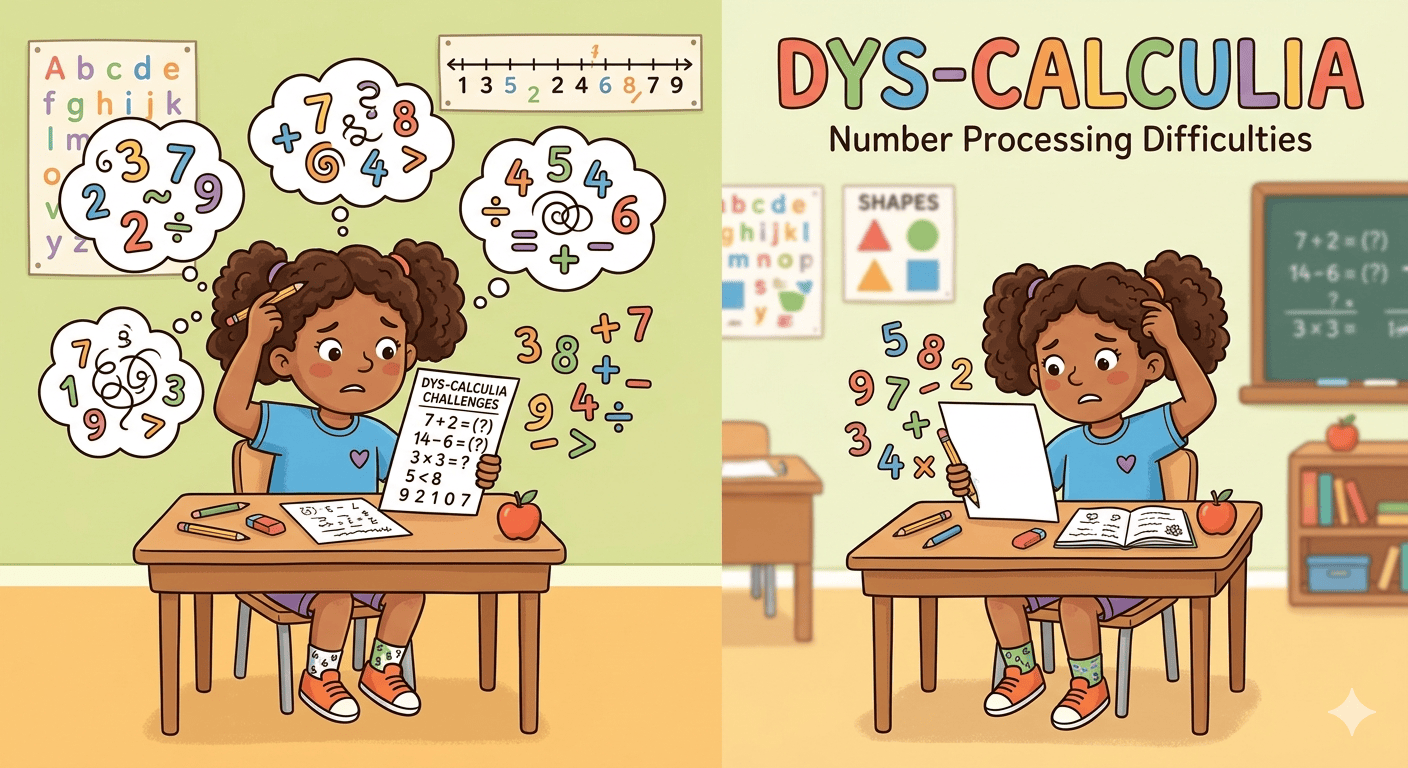
Dyscalculia is a specific learning disability that affects a child's ability to understand numbers, learn arithmetic facts, and carry out mathematical calculations. It is not a reflection of intelligence β€” children with dyscalculia often have strong abilities in other areas. With specialist support, they can develop effective strategies to achieve in maths.

Specialist dyscalculia and numeracy assessment
Individualised maths intervention programmes
Multisensory learning approaches
Concrete-pictorial-abstract teaching methods
Parent and teacher guidance for school support
Dyscalculia support and maths learning therapy at Growing Stars Lucknow
4.9 Β· 200+ Google Reviews
Recognise the Signs

Signs & Symptoms of
Dyscalculia

Recognising these signs early can make a significant difference. If your child shows several of these, seek a professional evaluation promptly.

Weak number sense

Difficulty understanding quantities, estimating amounts, comparing numbers, or grasping the concept that numerals represent quantities.

Trouble memorising arithmetic facts

Unable to reliably recall basic addition, subtraction, multiplication, or division facts despite repeated exposure and practice.

Counting on fingers beyond expected age

Continuing to rely on finger-counting for simple calculations well past the age when peers have automatised these facts.

Difficulty with place value

Struggling to understand the value of digits in different positions, making errors in multi-digit calculations and number reading.

Problems with time and sequencing

Difficulty reading clocks, understanding the passage of time, following multi-step instructions, and organising tasks in sequence.

Maths anxiety

Significant anxiety, avoidance, or distress associated with maths tasks, which can compound the learning difficulty over time.

Understanding the Condition

Causes & Contributing Factors

Understanding why Dyscalculia occurs helps families navigate the journey with clarity and confidence.

Neurological Differences

Dyscalculia is associated with differences in the parietal lobe β€” particularly the intraparietal sulcus β€” which plays a key role in numerical processing and magnitude representation.

Genetic Factors

Dyscalculia runs in families and has a significant heritable component, suggesting a strong genetic contribution to numerical processing differences.

Co-occurring Learning Differences

Dyscalculia frequently co-occurs with dyslexia, ADHD, and working memory difficulties, all of which can compound mathematical challenges.

Working Memory Deficits

Difficulties holding and manipulating numerical information in working memory make mental arithmetic and multi-step problem-solving particularly challenging.

How We Help

Our Approach to
Dyscalculia

A structured, compassionate process from first assessment to lasting outcomes β€” personalised to every child.

Step 01

Dyscalculia Assessment

Standardised assessment of numerical cognition, arithmetic skills, working memory, and related processing abilities to build a detailed learner profile.

Step 02

Individualised Intervention Plan

A targeted programme addressing the specific gaps and underlying processing challenges identified in the assessment.

Step 03

Concrete-Pictorial-Abstract Teaching

Building genuine conceptual understanding starting with physical objects, moving to visual representations, and then abstract number work.

Step 04

Multisensory Maths

Using tactile, visual, and movement-based approaches to encode number concepts and arithmetic procedures more deeply.

Step 05

Strategy Instruction

Teaching reliable, efficient strategies for calculation, estimation, and problem-solving that reduce reliance on rote memorisation.

Step 06

School & Parent Collaboration

Providing schools with accommodation recommendations and equipping parents with home practice strategies that build confidence alongside competence.

Expected Outcomes

What Families See
After Treatment

With consistent therapy and family involvement, children with Dyscalculia make meaningful, measurable progress at Growing Stars.

Stronger foundational number sense and conceptual understanding
Improved accuracy and fluency in arithmetic
Effective calculation strategies that reduce cognitive load
Greater confidence and reduced maths anxiety
Better academic performance in maths and related subjects
Practical life numeracy skills for everyday independence
Where to Find Us

Available at
Both Locations

Main Center

Aliganj Center

MM-271, Sector D, Aliganj, Lucknow
Mon–Sat: 9 AM – 7 PM

IIM Road Center

IIM Road, Near Rajhansh Public School, Lucknow
Mon–Sat: 10 AM – 6 PM
FAQ

Common Questions
About Dyscalculia

Still have questions? We're here to help. Reach out to our Lucknow team directly.

Contact Us

Dyscalculia affects approximately 3–6% of the population β€” a similar prevalence to dyslexia β€” but it is far less well recognised and receives significantly less attention in schools and in research. Many children with dyscalculia are identified late or not at all.

Yes. The two conditions co-occur in approximately 40–50% of cases. They share some underlying processing similarities, particularly in phonological working memory. A comprehensive assessment can identify the full profile of learning differences.

Not necessarily. With specialist intervention, children with dyscalculia can develop genuine conceptual understanding and reliable strategies. The goal is not to overcome the learning difference but to build effective tools and accommodations that allow the child to access and succeed in maths.

Helpful accommodations include extended time on maths tasks, use of a calculator, access to number lines and multiplication charts, reduced copying from the board, and breaking multi-step problems into smaller components. We provide schools with tailored accommodation recommendations.

Ready to Help Your Child
Overcome Dyscalculia?

Book a free 30-minute assessment at our Aliganj or IIM Road center. Our specialists will evaluate your child and design a personalised therapy plan.

Free assessment Β· No waiting list Β· Aliganj & IIM Road Centers

Related Conditions

These conditions often co-occur or share similar characteristics with Dyscalculia.

Recommended Therapies

Our evidence-based services that directly address Dyscalculia.