

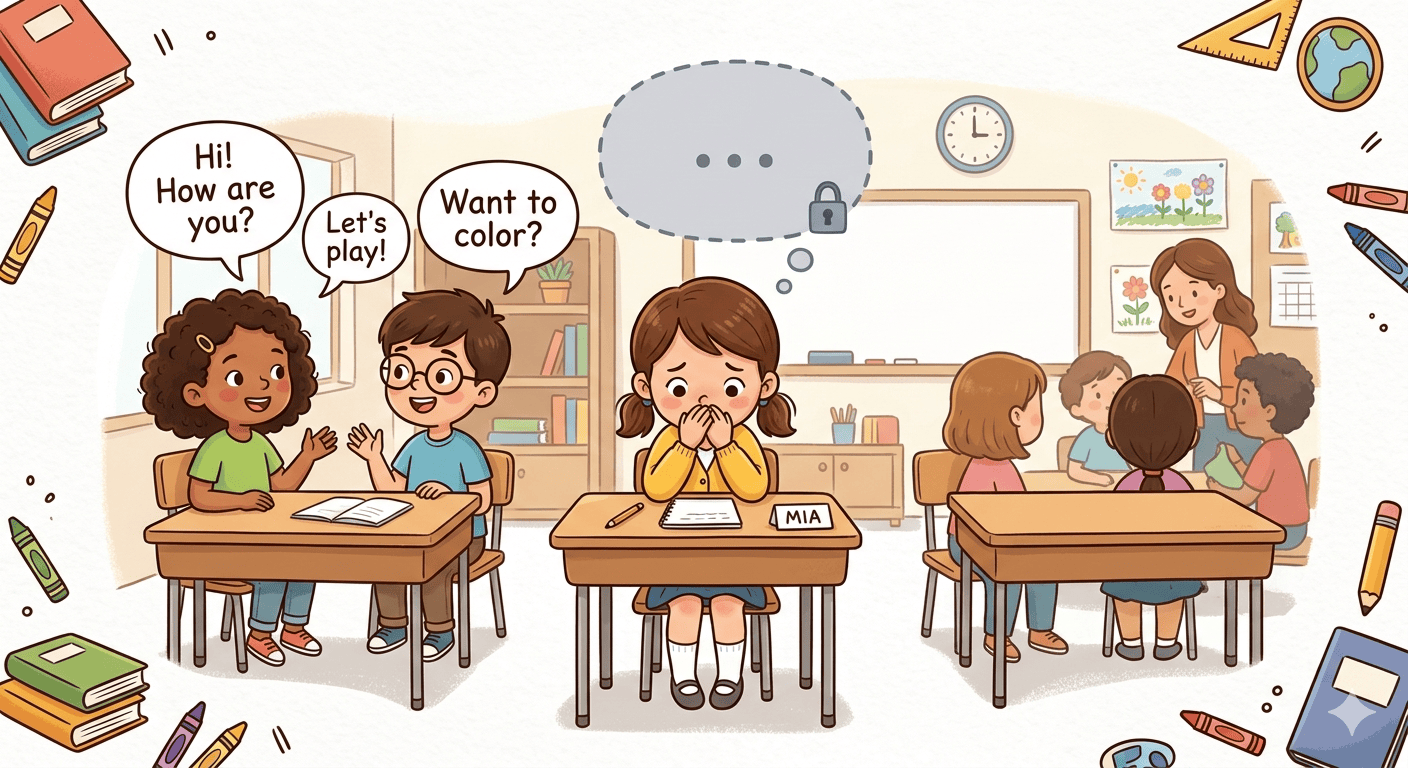
Early Intervention Matters: The earlier Selective Mutism is identified and treated, the better the outcomes. Children who receive evidence-based intervention before age 8 typically respond more quickly and completely. Avoid a 'wait and see' approach — SM rarely resolves without treatment.
Signs & Symptoms of
Selective Mutism
Recognising these signs early can make a significant difference. If your child shows several of these, seek a professional evaluation promptly.
Speaks at home but not at school
The most common pattern — fluent speech at home with family but complete inability to speak at school or in public.
Freezing or appearing blank
Child appears to freeze, go blank, or become expressionless in situations where speaking is expected.
Uses non-verbal communication only
Points, nods, gestures, or whispers rather than speaking in situations that trigger mutism.
Visible anxiety in speaking situations
Signs of anxiety — stiffness, avoidance of eye contact, clinging to parents, stomach aches — in triggering situations.
Consistent pattern across time
The inability to speak is consistent and persistent, not a one-off event. Must be present for more than one month.
No other speech or language disorder
The child has the speech and language skills to speak — the barrier is anxiety, not ability.
Our Approach to
Selective Mutism
A structured, compassionate process from first assessment to lasting outcomes — personalised to every child.
Assessment & Anxiety Profile
Understanding the child's speaking map — where, with whom, and in what situations speech occurs or is absent.
Building Trust & Safety
Creating a low-pressure, positive therapeutic relationship where the child feels safe without any expectation to speak.
Graduated Exposure (Sliding In)
Systematically and gently increasing communication demands in small, manageable steps from non-verbal to verbal.
School-Based Intervention
Working directly with teachers to implement in-classroom strategies that reduce anxiety and build speaking opportunities.
Parent & Teacher Training
Coaching adults on how to respond to SM — what helps (warm, non-pressuring interactions) and what harms (forcing, drawing attention).
Social Anxiety Management
Building coping strategies for anxiety and broadening comfort zones in social speaking situations.
What Families See
After Treatment
With consistent therapy and family involvement, children with Selective Mutism make meaningful, measurable progress at Growing Stars.
Available at
Both Locations
IIM Road Center
Common Questions
About Selective Mutism
Still have questions? We're here to help. Reach out to our Lucknow team directly.
Contact UsRelated Conditions
These conditions often co-occur or share similar characteristics with Selective Mutism.
Recommended Therapies
Our evidence-based services that directly address Selective Mutism.