
Logo Light
Logo Light
Contact Us
hello@growingstar.in
+91-6307034344
Mon - Sat (9AM - 7PM)

Follow Us

πŸ‘„ Speech & Language
Ages: 2–10 years

Articulation Disorder
Treatment in Lucknow

Finding the words, one sound at a time

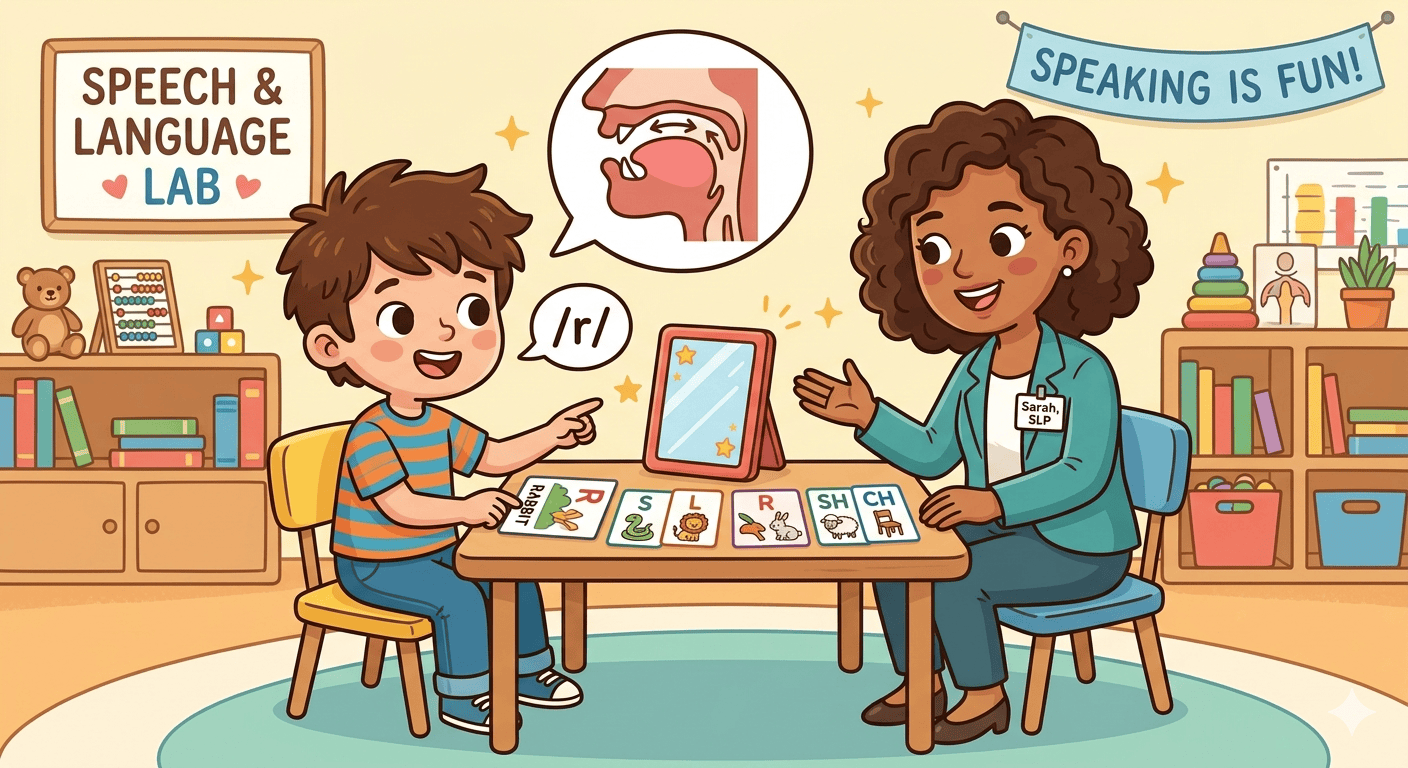
An articulation disorder is a speech sound disorder in which a child has persistent difficulty producing specific sounds correctly, making their speech difficult for others to understand. With early and targeted speech therapy, most children achieve clear, confident communication.

Comprehensive speech sound assessment
Individual articulation therapy
Phonological awareness training
Parent coaching and home practice programmes
School liaison and communication support
Articulation disorder speech therapy at Growing Stars Lucknow
4.9 Β· 200+ Google Reviews
Recognise the Signs

Signs & Symptoms of
Articulation Disorder

Recognising these signs early can make a significant difference. If your child shows several of these, seek a professional evaluation promptly.

Substituting sounds

Consistently replacing one sound with another, such as saying "wabbit" for "rabbit" or "tat" for "cat".

Omitting sounds

Leaving out sounds in words, especially at the beginning or end β€” for example, saying "ca" instead of "car".

Distorting sounds

Producing a sound in an approximate but incorrect way, such as a lateral lisp where "s" sounds like "sh".

Adding extra sounds

Inserting sounds into words where they do not belong, making speech sound unusual or unexpected to listeners.

Unclear speech beyond expected age

Speech that is difficult for unfamiliar listeners to understand past the age of 3–4 years, beyond typical developmental patterns.

Frustration or avoidance

Becoming upset or withdrawn when others cannot understand them, or avoiding speaking in social situations.

Understanding the Condition

Causes & Contributing Factors

Understanding why Articulation Disorder occurs helps families navigate the journey with clarity and confidence.

Motor Coordination Difficulties

Challenges with the precise movements of the lips, tongue, teeth, and jaw required to produce specific speech sounds correctly.

Hearing Loss

Even mild or fluctuating hearing loss due to ear infections or other causes can disrupt a child's ability to learn accurate speech sound production.

Structural Differences

Differences in oral anatomy such as a cleft palate, tongue tie, or dental issues can affect how sounds are produced.

Developmental Variation

Some children simply acquire sounds later than peers without a clear structural or neurological cause, particularly if there is a family history of speech difficulties.

How We Help

Our Approach to
Articulation Disorder

A structured, compassionate process from first assessment to lasting outcomes β€” personalised to every child.

Step 01

Speech Sound Assessment

Formal and informal evaluation of all speech sounds, oral motor skills, phonological awareness, and intelligibility in connected speech.

Step 02

Target Sound Selection

Identifying priority sounds based on developmental norms, impact on intelligibility, and the child's stimulability for quicker progress.

Step 03

Articulation Therapy

Structured practice of target sounds in isolation, syllables, words, sentences, and conversation using evidence-based techniques.

Step 04

Phonological Awareness Training

Building awareness of sound patterns within language to support both speech and early literacy development.

Step 05

Parent Coaching

Equipping parents with home practice activities, prompting techniques, and strategies to reinforce correct sound production daily.

Step 06

Generalisation & Monitoring

Supporting the child to use newly acquired sounds across all settings β€” home, school, and social environments.

Expected Outcomes

What Families See
After Treatment

With consistent therapy and family involvement, children with Articulation Disorder make meaningful, measurable progress at Growing Stars.

Clearer, more intelligible speech
Correct production of previously difficult sounds
Greater confidence in communication
Improved phonological awareness supporting literacy
Reduced frustration and improved social participation
Strong foundation for reading and writing development
Where to Find Us

Available at
Both Locations

Main Center

Aliganj Center

MM-271, Sector D, Aliganj, Lucknow
Mon–Sat: 9 AM – 7 PM

IIM Road Center

IIM Road, Near Rajhansh Public School, Lucknow
Mon–Sat: 10 AM – 6 PM
FAQ

Common Questions
About Articulation Disorder

Still have questions? We're here to help. Reach out to our Lucknow team directly.

Contact Us

Speech sound development follows a predictable sequence. Most children master all sounds by age 7–8. Some errors are completely typical in younger children β€” for instance, /r/ difficulty at age 4 is normal. Our speech therapists can assess whether your child's errors fall within typical development or warrant intervention.

If a child's speech is difficult for familiar adults to understand by age 2.5–3, or for unfamiliar adults by age 4, a speech assessment is recommended. Early intervention consistently leads to better outcomes.

The duration of therapy depends on the number and type of sounds affected, the child's age, and consistency of practice. Many children with mild articulation disorders make significant progress within a few months of weekly therapy supported by daily home practice.

Yes. Speech sound difficulties can impact phonological awareness β€” the ability to identify and manipulate sounds in language β€” which is a critical foundation for learning to read and spell. Addressing articulation early can support literacy development.

Ready to Help Your Child
Overcome Articulation Disorder?

Book a free 30-minute assessment at our Aliganj or IIM Road center. Our specialists will evaluate your child and design a personalised therapy plan.

Free assessment Β· No waiting list Β· Aliganj & IIM Road Centers

Related Conditions

These conditions often co-occur or share similar characteristics with Articulation Disorder.

Recommended Therapies

Our evidence-based services that directly address Articulation Disorder.