
Logo Light
Logo Light
Contact Us
hello@growingstar.in
+91-6307034344
Mon - Sat (9AM - 7PM)

Follow Us

✍️ Learning
Ages: 5+ years

Dysgraphia
Treatment in Lucknow

Writing made clear, comfortable, and confident

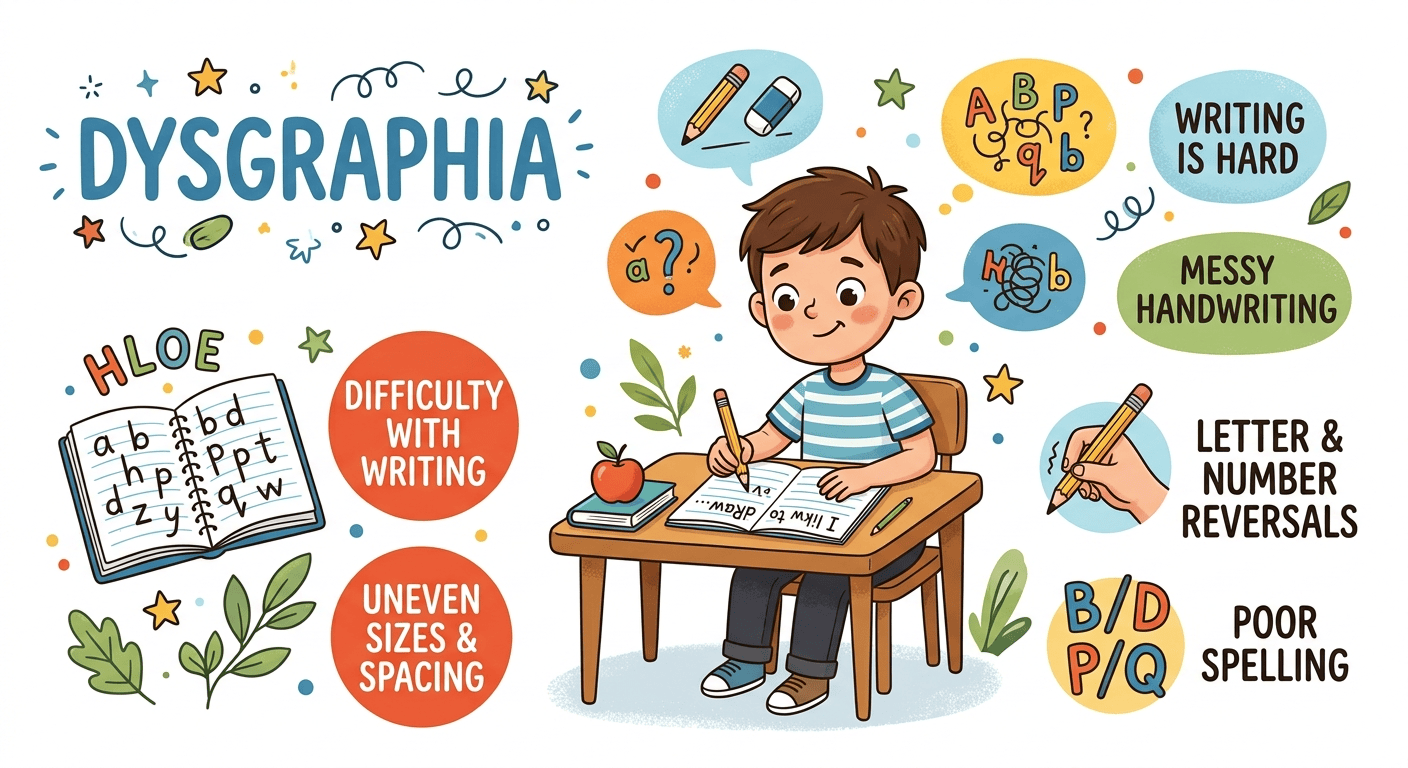
Dysgraphia is a learning disorder affecting the physical act of writing — including letter formation, spacing, size consistency, and written expression. Children with dysgraphia often have illegible handwriting, write very slowly, and find written tasks exhausting despite good verbal intelligence.

Occupational therapy for fine motor and handwriting
Pencil grip and pressure training
Multisensory handwriting programmes
Assistive technology guidance
School liaison for writing accommodations
Dysgraphia therapy at Growing Stars Lucknow
4.9 · 200+ Google Reviews
Recognise the Signs

Signs & Symptoms of
Dysgraphia

Recognising these signs early can make a significant difference. If your child shows several of these, seek a professional evaluation promptly.

Illegible handwriting

Inconsistent letter sizes, irregular spacing, letters that don't sit on the line, or a mix of upper and lower case.

Slow, effortful writing

Writing takes disproportionately long and requires significant effort, even for short tasks.

Poor pencil grip

Unusual or very tight pencil grip causing hand fatigue, cramping, or pain during writing.

Avoidance of writing tasks

Strong reluctance to write, producing much less than peers, or giving up quickly on written assignments.

Discrepancy between verbal and written skills

Can express ideas fluently verbally but struggles to transfer them to paper — the writing does not reflect the child's intelligence.

Mixing print and cursive

Inconsistently mixing handwriting styles within a single piece of writing.

Understanding the Condition

Causes & Contributing Factors

Understanding why Dysgraphia occurs helps families navigate the journey with clarity and confidence.

Motor Processing Differences

Difficulty planning and executing the fine motor movements required for writing, involving coordination of fingers, hands, and wrists.

Orthographic Processing

Problems with storing and retrieving letter forms from memory — making it hard to remember what letters look like when writing.

Co-occurring with Other Learning Disabilities

Dysgraphia commonly co-occurs with dyslexia, ADHD, and developmental coordination disorder (DCD/Dyspraxia).

Neurological Factors

Differences in how the brain coordinates the visual, motor, and language systems required for written language production.

How We Help

Our Approach to
Dysgraphia

A structured, compassionate process from first assessment to lasting outcomes — personalised to every child.

Step 01

Fine Motor & Handwriting Assessment

Evaluation of pencil grip, letter formation, writing speed, hand strength, and the impact on academic participation.

Step 02

Fine Motor Skill Development

Targeted activities to build the hand and finger strength, dexterity, and bilateral coordination needed for writing.

Step 03

Handwriting Programme

Structured handwriting instruction using programmes like Handwriting Without Tears to teach correct letter formation.

Step 04

Sensory Integration for Writing

Addressing tactile and proprioceptive processing differences that affect pencil pressure and grip.

Step 05

Assistive Technology

Introduction to typing, voice-to-text, and other technology to reduce the barrier that handwriting creates for written expression.

Step 06

School Accommodations

Providing schools with evidence to support extended time, typed submissions, and other reasonable adjustments.

Expected Outcomes

What Families See
After Treatment

With consistent therapy and family involvement, children with Dysgraphia make meaningful, measurable progress at Growing Stars.

More legible and consistent handwriting
Improved writing speed and endurance
Reduced physical discomfort during writing
Better organisation of written expression
Effective use of assistive technology
Increased academic participation and confidence
Where to Find Us

Available at
Both Locations

Main Center

Aliganj Center

MM-271, Sector D, Aliganj, Lucknow
Mon–Sat: 9 AM – 7 PM

IIM Road Center

IIM Road, Near Rajhansh Public School, Lucknow
Mon–Sat: 10 AM – 6 PM
FAQ

Common Questions
About Dysgraphia

Still have questions? We're here to help. Reach out to our Lucknow team directly.

Contact Us

No. Many children have untidy handwriting that improves with practice and maturation. Dysgraphia is a genuine learning disorder where handwriting difficulties persist despite instruction and practice, interfere with academic functioning, and cause significant effort and distress.

For many children with dysgraphia, learning to type efficiently is an important compensatory strategy that allows them to express themselves without the barrier of handwriting. We teach touch-typing alongside handwriting therapy, and support schools to accept typed work.

Possibly. Dysgraphia and dyslexia frequently co-occur, as do dysgraphia and ADHD. A comprehensive assessment will clarify whether multiple learning differences are present and help design a coordinated intervention plan.

Ready to Help Your Child
Overcome Dysgraphia?

Book a free 30-minute assessment at our Aliganj or IIM Road center. Our specialists will evaluate your child and design a personalised therapy plan.

Free assessment · No waiting list · Aliganj & IIM Road Centers

Related Conditions

These conditions often co-occur or share similar characteristics with Dysgraphia.

Recommended Therapies

Our evidence-based services that directly address Dysgraphia.